Proton transfer (PT) is one of the basic reactions that are of ultimate importance for different branches of chemistry, technology and biology. Its fundamental role in biochemistry and medicine [1] is demonstrated in almost all chemical reactions catalyzed by enzymes, operation of proton channels, generating proton gradients in the energy transduction machinery and DNA/RNA pairing. However, the lack of direct general experimental accessibility to observation of basic PT steps in biocatalysis and proton transport suggests looking at simplified systems that could allow deriving their inherent mechanisms together with estimation of their kinetic and thermodynamic variables and the factors that influence them. Many organic compounds can be used as such simplified models and it turns that such compounds exhibit useful properties as highly fluorescent (bio)sensors and imaging agents, OLEDs and molecular switches. These practical applications are based on excited-state intramolecular PT (ESIPT), where the proton is exchanged through intramolecular hydrogen bonding (N…HO or N…HN), causing dramatic changes in the electronic density distribution and resulting (in most of the cases) in red shifted emission. The observed emission lies at the base of use of organic molecules as ESIPT sensing and imaging fluorophores. However, these fluorophores still have many disadvantages such as sensitivity to the environment and short emission bandwidth, which opens additional room for further investigations of the ESIPT and design of systems where this elementary process is much more efficient and less sensitive to the medium. This is one of the aims of our current research which will be achieved by theoretical structural theoretical design, synthesis of promising fluorophores, spectral studies and further structural changes to make the ESIPT sensitive to a selected target binding.
The ESIPT in the sensing and imaging applications exploit the one-dimensional (through existing intramolecular hydrogen bonding) short-range PT. In general, the applicability of the PT for switching, i.e. for transfer of a signal at a single molecular level, has been demonstrated for the first time by IBM Zurich in 2009 [2]. The first systems were based namely on short-range PT and operated at harsh experimental conditions (low temperatures, vacuum and voltage triggered). In spite of the operational disadvantages, they have demonstrated the major advantages of PT based switching – superior fatigue resistance over all the other molecular switches. The light triggered switches, based on long-range PT, are called proton cranes, because the ESIPT process is accompanied by internal rotation, leading to delivery of the tautomeric proton from one side of the molecule to another. Very recently we have shown a proton crane with an unprecedented switching efficiency and fatigue resistance, operating in the visible region [3]. This opens the route for design of new and improving the existing tautomeric switches, pioneering work in unimolecular motors and robots, logic gates, and new molecular-level energy storage systems and proton-conducting membranes for fuel cells, which will be maximally exploited.
News
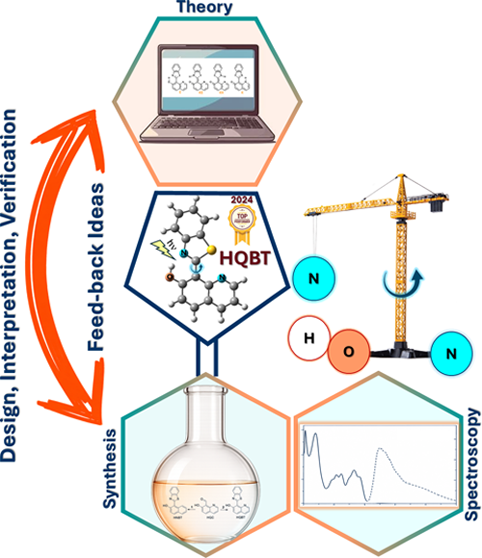
Proton Cranes ─ Tautomeric Systems for Intramolecular Cargo Delivery
Nature effectively employs the light-induced transfer of a proton for rapid interconversion between different electronic [...]
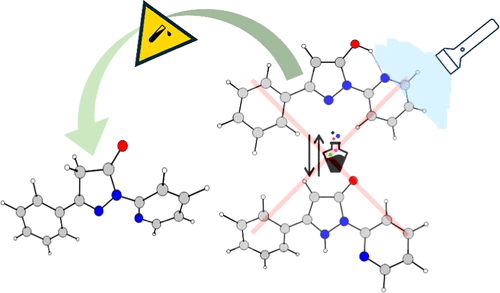
Tautomerism in 1-Pyridin-2-yl-1H-pyrazol-5-ols through the Prism of Molecular Switching: The Rare Case of OH/CH Switching upon Acidic Input
The tautomeric behavior of 1-(2-pyridinyl)-1H-pyrazol-5-ols has been investigated in solution using UV–vis and NMR spectroscopies [...]

Reversible Switching Based on Truly Intramolecular Long-Range Proton Transfer─Turning the Theoretical Concept into Experimental Reality
Herein, we demonstrate a working prototype of a conjugated proton crane, a reversible tautomeric switching [...]