Since its discovery the tautomerism is considered as one of the most difficult dynamic processes to study. The fast proton transfer (PT) (typically in the fs to ns time scale) makes the process “fast” for the NMR, while vibrational spectroscopy suffers limited number of solvents. Over the period of more than 150 years absorption and emission spectroscopies in the UV-Vis region have been the major tool in study of tautomerism in organic molecules. Impossibility the separate the individual forms in a tautomeric mixture experimentally, and hence, their unknown spectral characteristics, marked most of the studies as descriptive and qualitative in terms of position of the equilibrium and exact estimation of the factors that affect it. The major breakthrough in this direction was achieved by the development of advanced chemometric tools [1,2,3] for data processing, where we are one of the major contributors. In his historical perspective [4] on the tautomeric research, one of the pioneers in this area, Jose Elguero, stressed that most of the used experimental procedures (optical spectroscopies and NMR), due to the inborn limitations, reached their limits for further development and the major hopes for progress are related to theoretical chemistry. The problems in using theoretical chemistry in the tautomeric research are the same general problems that theoretical chemistry experiences nowadays: impossibility for systematic improvement of the affordable DFT methods; limitations of the commonly used implicit solvation models in describing specific solute-solvation interactions; needs for efficient and affordable methods for excited state description.
The current aim of our research in this topic is to support the process of finding and testing of solutions, suitable for the tautomeric research and for realistic predictability of tautomeric state and PT mechanism. We are not developers of the DFT methodology and our contribution could be to create and maintain a tautomeric database, where exact and reliable experimental information for tautomeric processes (equilibrium constants and related thermodynamic parameters) will be collected to be used for benchmarking and improvement by the theoretical methods developers. It is fair to note that this is a hot topic now in the cheminformatics and such attempts have been already done for aqueous environment, but our aim is to advance further by using our unique know-how and to provide exact, in quantitative terms, information for many tautomeric systems in various environment, suitable to “validate” the DFT methodology. This direction of work will bring the necessary tools for realistic structural design in the excited state proton transfer and drug design fields. In respect of the specific solvation, we will use our available and will obtain new information about the tautomeric state and PT mechanism in bioactive molecules (curcumin, polyphenols, tetramic acid derivatives, drugs and natural products based on 4-hydroxyquinolines, etc., as examples for which we have previous experience) in order to test the existing pure and hybrid approaches for explicit solvation (MM, MD, MC, QM/MM, etc.) and to get more experience and know-how in this direction. Special attention will be given to the aqueous environment in relation to the drug design.
News
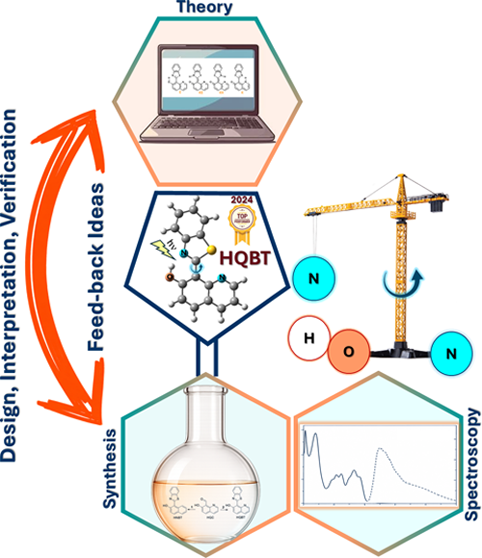
Proton Cranes ─ Tautomeric Systems for Intramolecular Cargo Delivery
Nature effectively employs the light-induced transfer of a proton for rapid interconversion between different electronic [...]
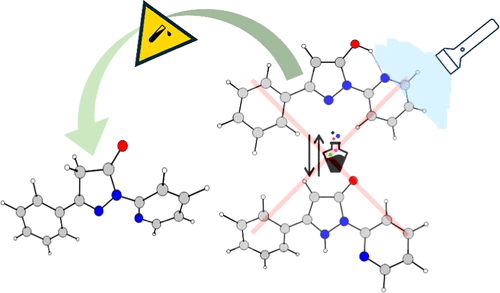
Tautomerism in 1-Pyridin-2-yl-1H-pyrazol-5-ols through the Prism of Molecular Switching: The Rare Case of OH/CH Switching upon Acidic Input
The tautomeric behavior of 1-(2-pyridinyl)-1H-pyrazol-5-ols has been investigated in solution using UV–vis and NMR spectroscopies [...]

Reversible Switching Based on Truly Intramolecular Long-Range Proton Transfer─Turning the Theoretical Concept into Experimental Reality
Herein, we demonstrate a working prototype of a conjugated proton crane, a reversible tautomeric switching [...]